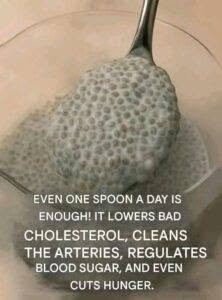
If you’re checking the headline “Even just one spoonful a day is enough! It lowers bad cholesterol, cleans arteries, regulates blood sugar, and even suppresses hunger,” it is most likely referring to a soluble-fiber food or supplement such as psyllium husk.
There is a kernel of truth, but “cleans arteries” is misleading.
What soluble fiber can actually do
- Lower LDL cholesterol: Soluble fiber can reduce LDL (“bad”) cholesterol. A large review of randomized trials found that soluble-fiber supplementation produced a modest average reduction in LDL.
- Help blood-sugar control: Viscous soluble fiber slows digestion and glucose absorption and can improve post-meal blood-sugar control.
- Increase fullness: Fiber can slow digestion and help you feel full for longer, potentially reducing calorie intake.
- “Clean arteries”: This is not an accurate description. Soluble fiber can help lower circulating LDL, but it does not literally scrub existing plaque out of your arteries.
If it’s psyllium
One tablespoon of ground psyllium provides roughly 5–6 g of soluble fiber, according to NHLBI data. But the benefit depends on the total daily amount and overall diet, not a magical single spoonful.
If you take psyllium, mix it with plenty of fluid and follow the product directions. Increasing fiber too quickly can cause gas, bloating, or abdominal cramps.