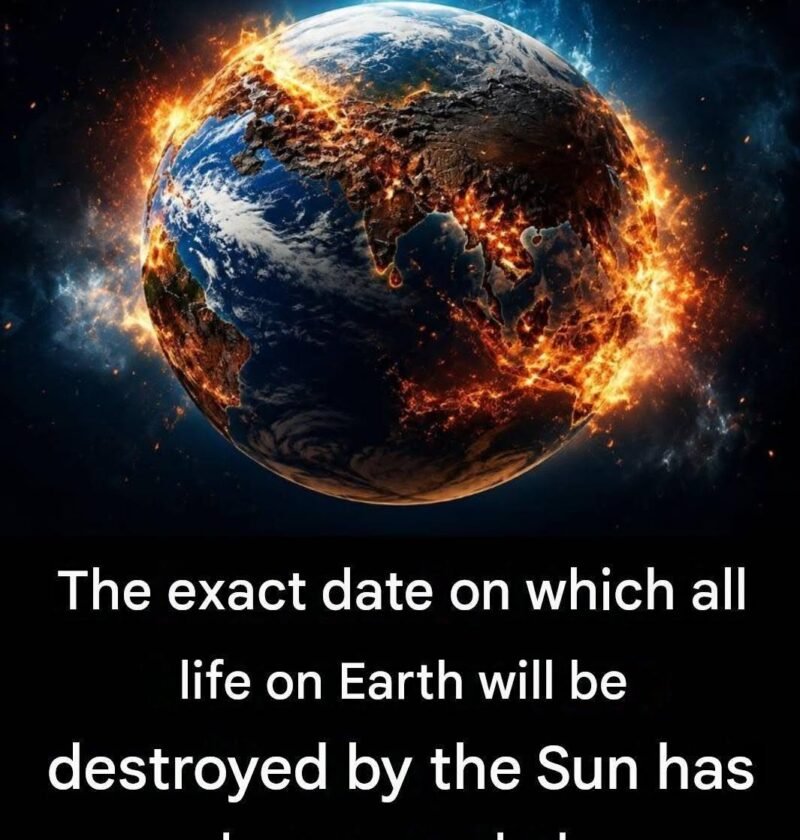
Earth’s biosphere will remain habitable for roughly another 1 billion years—not because of an asteroid or human activity, but because the Sun is slowly getting brighter.
Viral headlines claiming scientists “finally dated the end of life on Earth” refer to climate and biogeochemical modeling (notably a well-known 2021 Nature Geoscience study by Kazumi Ozaki and Christopher Reinhard) that calculated when Earth’s oxygen-rich atmosphere will collapse as the Sun ages.
The Real Scientific Timeline of Earth’s Habitability
| Approximate Timeframe | What Happens to the Sun & Earth | Impact on Life |
| Present Day | The Sun is ~30% brighter than when Earth formed 4.5 billion years ago; Earth maintains an oxygen-rich atmosphere (~21% $\text{O}_2$). | Complex plants, animals, and humans thrive. |
| ~500–600 Million Years from Now | Rising solar luminosity accelerates weathering of silicate rocks, pulling carbon dioxide ($\text{CO}_2$) out of the atmosphere. | $\text{CO}_2$ drops too low for most standard plants ($\text{C}_3$ photosynthesis) to survive; forests and crops die off. |
| ~1 Billion Years from Now | $\text{CO}_2$ falls below the threshold even hardy plants ($\text{C}_4$ photosynthesis) need. Photosynthesis halts completely. | Atmospheric oxygen plummets back to near-zero (similar to early Earth before the Great Oxidation Event). Complex animal and plant life ends; only anaerobic microbes survive. |
| ~1.1–1.5 Billion Years from Now | Solar brightness increases by ~10%, triggering a moist/runaway greenhouse state where oceans begin evaporating into space. | Surface water boils away, leaving Earth a scorching, sterile desert. |
| ~5–7.5 Billion Years from Now | The Sun exhausts its core hydrogen and expands into a Red Giant. | Mercury and Venus are engulfed; Earth is either swallowed or scorched into a molten cinder. |
What Most Clickbait Headlines Leave Out
-
It is not a sudden countdown or imminent threat: One billion years is more than twice as long as animals have existed on Earth (complex animals appeared roughly 600 million years ago).
-
Plants suffocate before Earth boils: Counterintuitively, complex life ends from carbon dioxide starvation before the oceans evaporate. A hotter Sun speeds up chemical weathering in rocks, trapping $\text{CO}_2$ underground until plants can no longer photosynthesize or produce oxygen.
-
Why astrobiologists care: Scientists modeled this exact timeline not to predict human doom, but to help exoplanet telescopes (like the James Webb Space Telescope) estimate how long habitable, oxygen-bearing worlds stay detectable across the galaxy.