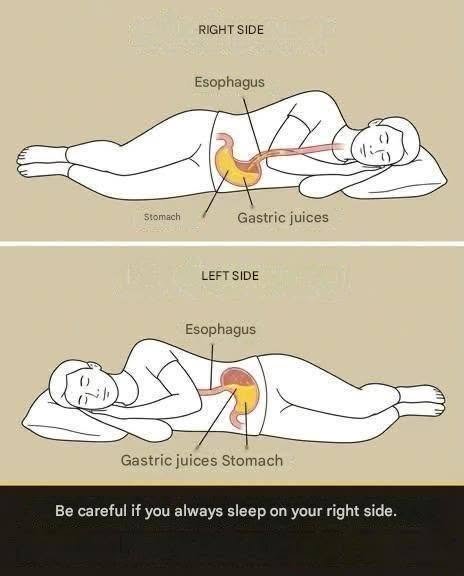
Truncated hooks like “Remember that if you always sleep on your right side, you… Read more” cut off right before the payoff to force a click—and then usually inflate real anatomy into dramatic warnings. Sleeping on your right side is not inherently dangerous for most healthy people, though anatomical geometry means it behaves differently from left-side sleeping in a few specific situations—such as acid reflux/heartburn, late pregnancy, or certain heart/circulation conditions.
Inside the body, organs are cushioned and supported by ligaments, fascia, and abdominal pressure; they don’t simply “slosh” or get crushed just from lying on one side. Still, gravity and internal layout do create real trade-offs depending on your health context.
What “Right-Side Sleeping” Actually Affects vs. Viral Overstatements
| Topic Often Used in “Read More” Hooks | What Happens Anatomically | Practical Reality |
| Acid Reflux & Heartburn | The esophagus enters the stomach from an angle where left-side sleeping tends to keep the gastroesophageal junction higher above stomach acid; right-side sleeping can relax the lower esophageal sphincter slightly and allow reflux more easily in reflux-prone people. | If you get nighttime heartburn or regurgitation, trying left-side elevation often helps more than any “detox” or posture trick. |
| Pregnancy (Especially Later Trimesters) | Lying flat on the back—and to a lesser extent on the right—can place more weight on major vessels like the inferior vena cava, while left-side sleeping is traditionally favored to support blood flow and reduce pressure. | Side sleeping is generally preferred over back sleeping later in pregnancy, and shifting positions for comfort is normal. |
| Heart Failure or Certain Heart Conditions | Some people with heart failure or specific arrhythmias notice more awareness of their heartbeat, mild discomfort, or shortness of breath when lying on their left or right side due to chest/fluid mechanics. | Comfort and breathing cues matter—if lying on one side triggers symptoms or breathlessness, mention it to a doctor. |
| Brain “Glymphatic” Waste Clearance & Snoring | Animal and imaging research explores how body posture influences fluid flow and airway openness, and side sleeping generally reduces airway collapse compared with back sleeping for snoring/sleep apnea. | There is no magic “right side = ruined brain” rule; airway openness and sleep quality depend far more on back vs. side position, pillow support, and breathing issues. |
Why “Remember That If You Always Sleep on Your Right Side, You…” Hooks Work
-
The Ellipsis Cliffhanger: Cutting off mid-sentence (“you…”) creates open-loop curiosity that makes you want to finish the thought even before knowing whether the claim is sound.
-
Real Anatomy Turned Into Fear: Because the stomach, liver, heart, and major blood vessels sit asymmetrically, posts can take a real physiological nuance (like reflux or pregnancy blood flow) and frame right-side sleeping as a silent hazard.
-
Most People Shift Naturally Anyway: Even people who feel they “always” sleep on one side usually change positions multiple times overnight without realizing it.
What Actually Matters for Sleep Position
-
Let Comfort and Symptoms Guide You: For most healthy adults, the best sleep position is the one that keeps your neck and spine fairly neutral, lets you breathe comfortably, and doesn’t trigger reflux, shoulder/hip pain, or numbness.
-
Adjust Support Instead of Chasing Fear: A supportive pillow between the knees (for side sleepers) or under the head/neck often resolves morning stiffness far better than stressing over left vs. right trivia.