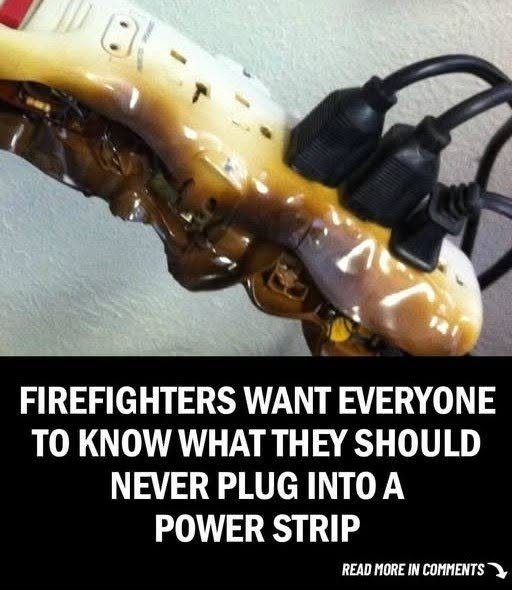
While power strips and surge protectors are convenient tools for expanding your wall outlets, plugging the wrong appliances into them can quickly overload the circuit, damage your electronics, or even cause an electrical fire. A standard power strip is designed to handle low-to-moderate wattage, not heavy-duty power demands.
According to electrical safety experts, here are the things you should never plug into a power strip:
1. Other Power Strips or Extension Cords (“Daisy Chaining”)
-
The Danger: Plugging one power strip into another (or into an extension cord) is one of the leading causes of electrical fires.
-
Why it happens: Daisy chaining multiplies the electrical load across a single wall outlet and a thin wire gauge that was never designed to carry that much cumulative current. This causes the cords to overheat rapidly, melting the plastic insulation and sparking a fire. Always plug high-demand electronics directly into a wall outlet.
2. Space Heaters and Portable Radiators
-
The Danger: Space heaters pull an enormous amount of electricity—often between 1,500 watts, which is the maximum capacity of a standard household circuit.
-
Why it happens: Power strips simply cannot handle sustained high-wattage draws. If you plug a space heater into a power strip, the strip’s internal wiring will overheat quickly, potentially melting the casing or triggering a short circuit.
3. Kitchen Appliances (Microwaves, Toasters, and Coffee Makers)
-
The Danger: High-heat kitchen appliances draw massive amounts of power to generate heat quickly.
-
Why it happens: A microwave, toaster oven, blender, or coffee maker can easily max out or exceed a power strip’s wattage limit. Running a toaster and coffee maker on the same power strip will almost instantly trip your circuit breaker or cause overheating. Always plug these directly into wall outlets, preferably on dedicated kitchen circuits.
4. Refrigerators and Freezers
-
The Danger: Refrigerators pull intermittent power surges when their compressors kick on.
-
Why it happens: While they run continuously, the sudden spike in electrical draw needed to start the compressor can overload a power strip. Furthermore, if a power strip is accidentally bumped or turned off, it cuts power to your fridge, leading to spoiled food and potential compressor damage.
5. Hair Styling Tools (Blow Dryers, Curling Irons, and Straighteners)
-
The Danger: Hair dryers are notorious power hogs, frequently drawing 1,500 to 1,800 watts—the exact limit of an entire household circuit.
-
Why it happens: Using a blow dryer or hair straightener through a power strip (especially in a humid bathroom environment) creates an extreme fire and shock hazard due to overheating and overloading.
Safety Rule of Thumb: Power strips are great for low-wattage electronics like phone chargers, lamps, routers, and computer monitors. Anything that generates heat (heaters, toasters, hair tools) or relies on a heavy motor (refrigerators, heavy power tools) belongs directly in a wall outlet.
Have you ever noticed a power strip getting warm to the touch, or are you checking your setup for home safety?