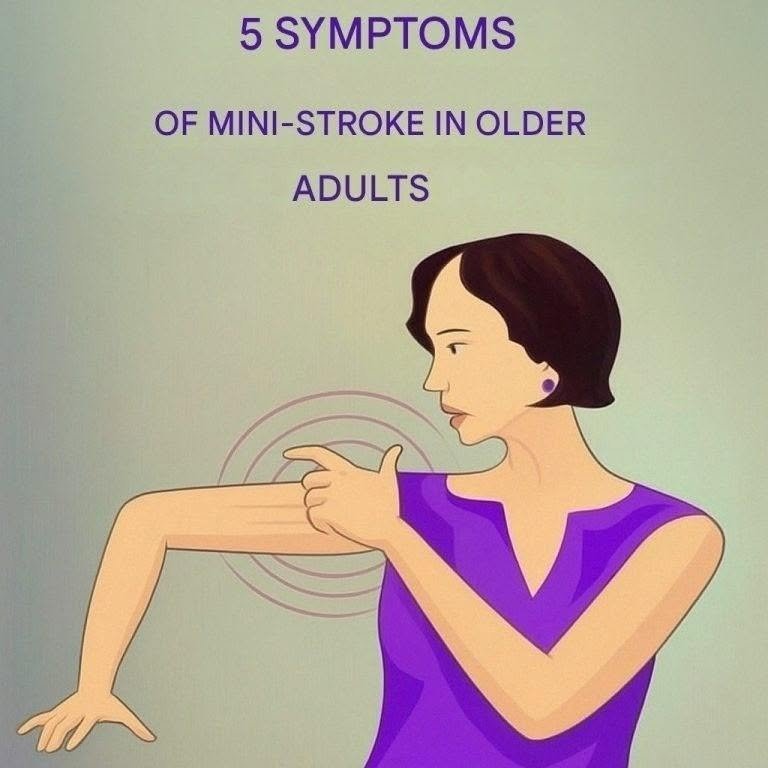
Recognizing the signs of a transient ischemic attack (TIA), commonly known as a **mini-stroke**, is critical. A TIA occurs when blood flow to a part of the brain is briefly blocked. While symptoms typically resolve within minutes to hours, a TIA is a major warning sign—often a precursor to a full-blown stroke.
Here are **5 critical symptoms** of a mini-stroke in older adults that should never be ignored:
—
### 1. Sudden Weakness or Numbness
* **What it looks like:** A sudden loss of strength or a heavy, numb feeling, typically affecting **one side of the body** (e.g., an arm, leg, or one entire side of the face).
* **What to test:** Ask the person to smile (watch for a drooping mouth) and raise both arms. If one arm drifts downward or they cannot lift it equally, it is a major red flag.
### 2. Sudden Confusion, Trouble Speaking, or Difficulty Understanding
* **What it looks like:** The person may suddenly slur their words, use completely incorrect words, or struggle to get thoughts out. Alternatively, they might look completely bewildered and have trouble understanding simple spoken sentences.
* **What to test:** Ask them to repeat a simple phrase, such as *”The grass is green.”* If their speech is slurred or garbled, act immediately.
### 3. Sudden Trouble Seeing in One or Both Eyes
* **What it looks like:** A sudden blurring, darkening, or complete loss of vision in one or both eyes. Some older adults might describe a “shadow” or a curtain coming down over their field of vision, or experience double vision.
### 4. Sudden Trouble Walking, Dizziness, or Loss of Balance
* **What it looks like:** A sudden, unexplained loss of coordination or stability. The older adult may stumble, feel extremely dizzy, or lean heavily to one side while trying to walk.
* **Note:** While general dizziness can have many causes, sudden and severe imbalance accompanied by any other symptom on this list strongly points toward a neurological event.
### 5. Sudden Severe Headache with No Known Cause
* **What it looksLike:** A sudden, intensely painful headache that hits out of nowhere, often described as the “worst headache of their life.” It may be accompanied by vomiting, dizziness, or altered consciousness.
* **Note:** While more commonly associated with hemorrhagic strokes, a sudden severe headache can also accompany certain types of TIAs or signal an impending stroke.
—
> [!IMPORTANT]
> **Think FAST:** When evaluating a potential stroke or mini-stroke, remember the acronym **FAST**:
> * **F**ace Drooping: Does one side of the face droop?
> * **A**rm Weakness: Does one arm drift downward?
> * **S**peech Difficulty: Is speech slurred or strange?
> * **T**ime to call emergency services: Even if symptoms disappear quickly, **call emergency services (such as 911) immediately**. A TIA requires urgent medical evaluation to prevent a major stroke.
>
>
—
Would you like to know more about the difference between a mini-stroke and a full stroke, or what steps doctors take to evaluate a TIA?