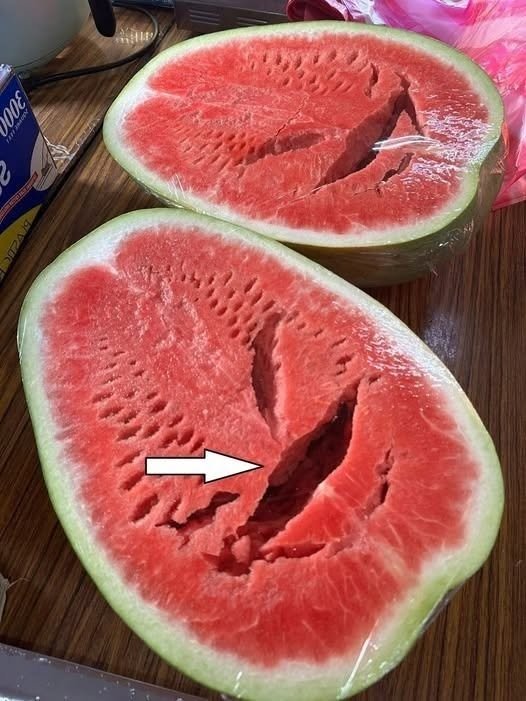
Despite sensational internet warnings, you **do not** need to throw away a watermelon just because you found cracks on the inside.
That internal splitting is a harmless agricultural phenomenon known as **”hollow heart”** (or hollow-heart syndrome).
### What Causes It?
* **Pollination Issues:** It typically happens when a watermelon doesn’t get fully or evenly pollinated during its growth stage, or experiences sudden shifts in weather and rapid growth spurts.
* **The Structure:** Because the internal tissue fails to fill every single space inside the rind, it splits open or forms a loose, swirly pattern—often dividing symmetrically into thirds.
### Is It Safe to Eat?
**Yes, it is entirely safe.**
* Hollow heart is a growth disorder, not a disease, rot, or bacterial contamination.
* In fact, many people find that hollow-heart watermelons are **sweeter** because the sugars are more concentrated around the fissures.
* The only downside is a textural one: in more severe cases, the flesh right near the cracks can occasionally look a bit dry or mealy. If that part tastes unappealing, you can simply slice it off and enjoy the rest.
**When *should* you throw a watermelon out?**
Discard it only if it smells fermented or sour, is excessively mushy, or shows visible signs of mold or rot coming from the outside in. Otherwise, a cracked interior just means nature got a little creative!