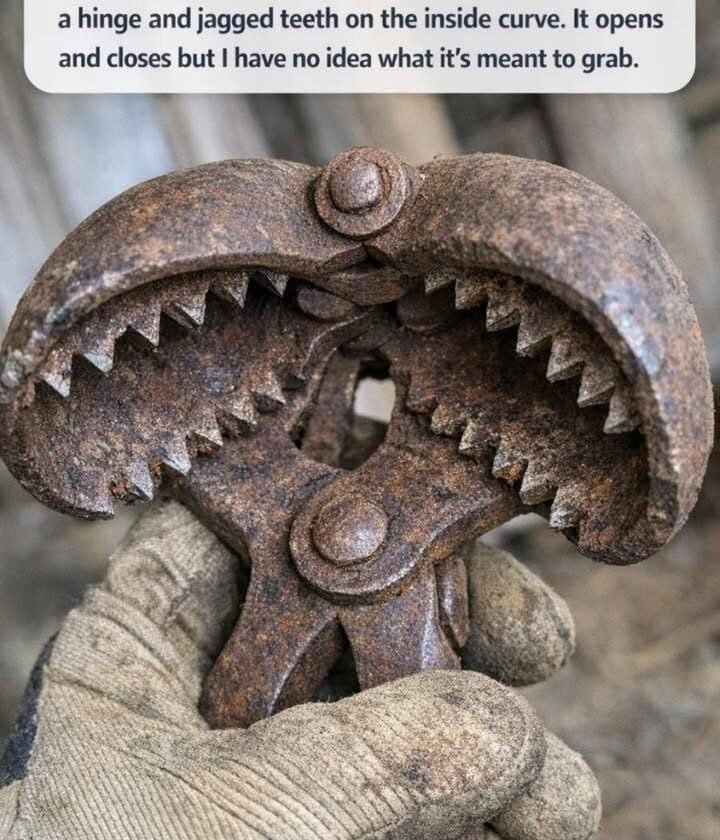
Based on your description—a heavy iron tool with a hinge and jagged teeth lining an inside curve—you likely have one of a few classic homestead or farm implements. Because barns accumulated tools from many eras, tools matching this general description usually fall into a few common categories:
1. A Root or Cabbage Cutter (or Sugar Beet Knife)
-
What it is: Historically used in livestock or farm operations to chop up hard root vegetables (like beets, turnips, or mangels) or heads of cabbage into smaller pieces so animals could chew them safely.
-
Design: It typically features a heavy curved blade or a jaw with coarse, jagged teeth/serrations that closes down or pivots on a hinge to slice through dense vegetation.
2. An Ice Tong (or Block Ice Grabber)
-
What it is: Used back in the days before modern refrigeration to lift and carry large blocks of ice.
-
Design: They are heavy iron tools built on a scissor-like hinge. The business ends curve inward and end in sharp, jagged teeth or spikes designed to bite deeply into the ice block so it wouldn’t slip when hoisted.
3. A Farrier’s or Veterinary Tool (Historical Livestock Instrument)
-
What it is: Old barns frequently harbor obsolete animal husbandry or veterinary tools.
-
Design: Specialized antique medical or dental tools for livestock (such as old tooth extractors or obstetrical instruments) often feature heavy forged iron, a pivot hinge, and serrated or grasping jaws designed to hold onto hard surfaces or bone.
How to Narrow It Down:
-
Are the teeth sharp like blades (for cutting), or are they spike-like points (for grabbing/biting into something)? If they are sharp cutting edges, it’s likely a chopper/cutter. If they are pointed spikes, it’s more likely a grabbing tool like ice tongs.
-
Are there any stamps, letters, or numbers forged into the metal near the hinge? Manufacturers often stamped initials or patent dates there, which can give away the exact tool.