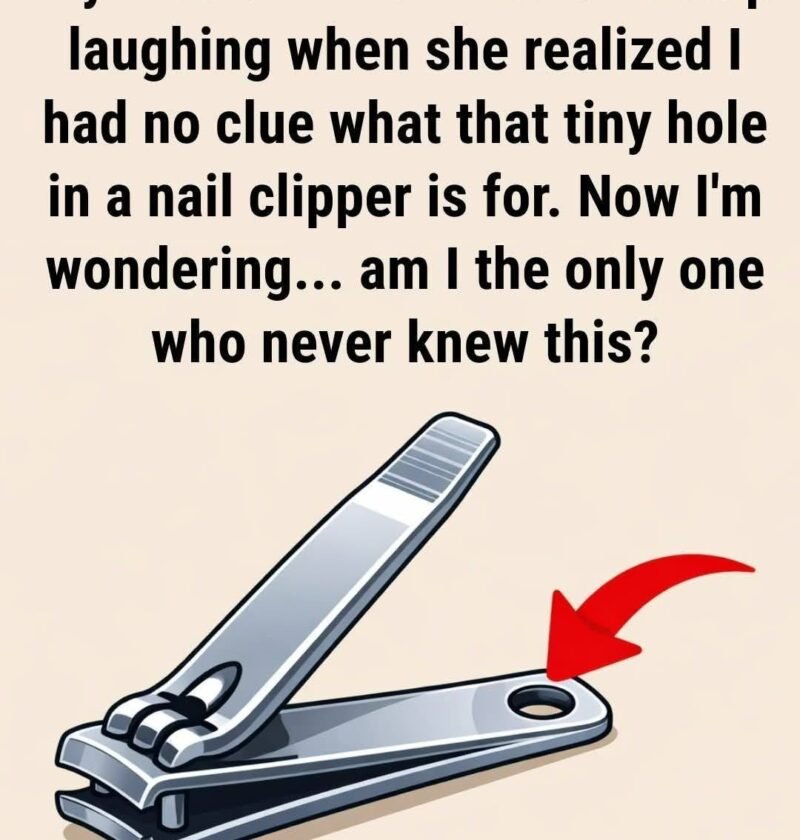
Absolutely—there’s a little more to that tiny hole than many people realize, but its purpose depends on exactly where the hole is located.
Ever Noticed That Tiny Hole on Your Nail Clipper? Here’s What It’s Actually For
Most nail clippers have a small hole or opening somewhere in the metal body. It can look like a deliberately designed feature for cleaning underneath your nails, but that’s generally not what it’s for.
1. If the hole is near the lever
On many standard lever-style clippers, the hole is related to the pivot and assembly of the clipper. The lever needs to rotate against the body while transferring pressure to the cutting jaws. A pin or fastener passes through this area to keep the mechanism together.
In other words, that seemingly insignificant hole can be part of what allows the clipper to open, close, and generate enough leverage to cut the nail.
2. Some holes are for hanging or carrying the clipper
If the hole is at the end of the clipper’s body, away from the cutting jaws, it may simply be an attachment point. Manufacturers can use it to connect the clipper to a key ring, chain, lanyard, or storage loop.
This is particularly common with compact travel clippers.
3. Don’t assume it’s a nail-cleaning tool
Some people use openings on nail clippers to scrape dirt from underneath their nails. That’s not necessarily what the manufacturer intended, and using a sharp metal edge this way can damage the skin underneath the nail or introduce bacteria.
If you need to clean beneath your nails, a dedicated soft nail brush is generally a better choice.
4. Why does the design look so mysterious?
Nail clippers are deceptively simple. The cutting jaws, pivot, lever, and spring action all have to work together. Small openings and holes can therefore serve mechanical, manufacturing, or attachment purposes rather than being an extra grooming function.
And there’s an important catch: not every nail clipper has the same hole for the same reason. The location and construction matter.
The bottom line
That tiny hole isn’t necessarily a hidden trick or a special feature for your nails. If it’s near the mechanism, it’s likely part of the clipper’s construction; if it’s at the end, it may be intended for attaching or hanging the tool.
So before poking, scraping, or inserting anything into it, look at where the hole is positioned and how your particular clipper is constructed.