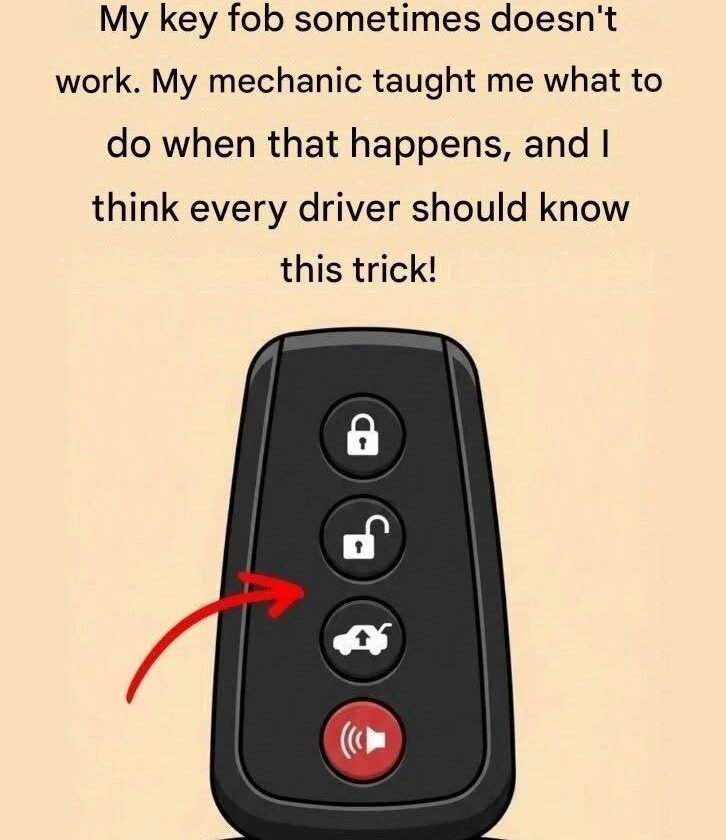
When your key fob suddenly stops working—whether it’s the battery dying, signal interference, or a desynced remote—getting locked out or stranded can be frustrating. Before you pay for an expensive locksmith or a tow truck, try these clever hacks to get your car unlocked and started.
1. The Chin Amplifier (Body Resonance Hack)
-
How to do it: Place the key fob directly under your chin and press the unlock button while pointing the key toward your car.
-
Why it works: Your skull and bodily fluids act as a biological conductor, temporarily boosting the radio frequency signal range and helping it reach the car’s receiver. (It sounds bizarre, but it genuinely works from an extra 20 to 30 feet away!)
2. Locate and Use the Hidden Physical Key
-
How to do it: Almost all modern key fobs contain a hidden mechanical key blade tucked inside or sliding out via a small release button or switch. Pop it out, look for the hidden keyhole usually concealed beneath a plastic cap on the driver’s door handle, and open the door manually.
-
Why it works: Even push-to-start cars with “smart keys” still have a physical lock cylinder as a mechanical backup for emergencies.
3. Tap or Twist the Fob to Reset a Loose Battery
-
How to do it: Give the fob a firm tap against the palm of your hand, or gently squeeze the casing together. Alternatively, pop the fob open, take the coin-cell battery out, wipe it clean, and snap it back in.
-
Why it works: Over time, vibrations from dropping your keys or daily wear can cause the internal battery terminals to lose connection. Re-seating the battery or fixing a loose connection often restores power instantly.
4. Find Your Car’s Secret Emergency Start Spot
-
How to do it: If your doors are open (or you unlocked them manually) but the push-to-start button says “Key Not Detected,” consult your manual for your car’s emergency RFID spot. For many push-to-start vehicles, you can start the car by holding the dead key fob directly against the start button, or by placing it inside the center console storage bin, cup holder slot, or steering column notch where a backup transponder coil is hidden.
-
Why it works: Even if the fob’s battery is completely dead, cars have a short-range chip reader (RFID/immobilizer) that can power the fob via magnetic induction when it’s held right up against the designated spot.
5. Check for Local Radio/Signal Interference
-
How to do it: If your fob worked fine a moment ago in your driveway but won’t work in a specific parking lot, move the key fob physically closer to the car’s windshield or driver’s side window (within 1 to 2 feet).
-
Why it works: Strong localized radio frequencies—such as power lines, military bases, radio towers, or even faulty aftermarket dash cams and phone chargers plugged into your car—can block the fob’s weak signal. Getting right next to the receiver overrides the interference.
6. Cycle the Ignition or Disconnect the Battery (If Inside)
-
How to do it: If you are already inside the vehicle and the car’s computer system has frozen or failed to recognize the security handshake from the fob, locking and unlocking the manual door switches or disconnecting the car’s main 12V battery for 5 minutes can hard-reset the body control module (BCM).
-
Why it works: Just like a computer, a car’s onboard computer modules occasionally glitch and fail to recognize valid key signals until rebooted.
Pro-Tip for Prevention:Keep a spare CR2032 or CR2025 coin-cell battery (the most common types used in fobs) in your glove box or wallet. Replacing a dying battery takes less than a minute and prevents you from getting stranded in the first place.
Did your key fob completely quit on you, or are you looking for tips to prep just in case it happens?