Small White Spots on Your Arms and Legs — What Could They Mean?
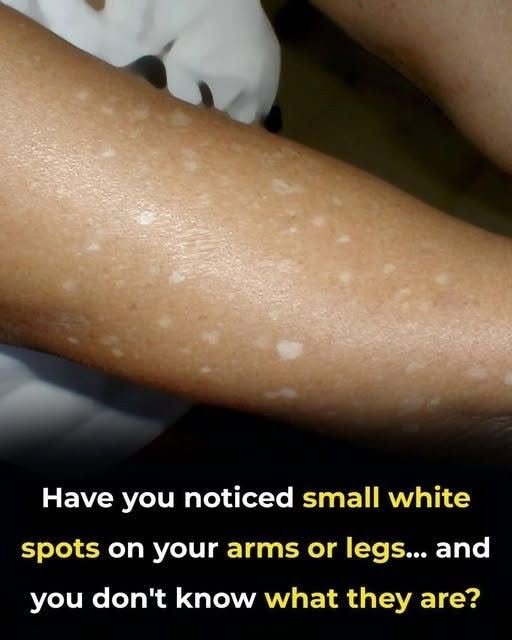
Small white or pale spots are fairly common and often harmless, but there are several possible causes. The appearance, location, whether they have scale or itching, and whether they’re spreading all matter.
1. ☀️ Idiopathic guttate hypomelanosis (IGH)
One of the most common explanations—especially in middle-aged and older adults—is idiopathic guttate hypomelanosis. It produces multiple tiny, flat, pale or porcelain-white spots, commonly on the forearms and shins. Long-term sun exposure and aging are thought to contribute. It is benign and usually doesn’t require treatment.
2. 🍄 Tinea versicolor
This is a yeast-related skin condition that can produce lighter patches, sometimes with very fine scaling. It is more common in warm, humid conditions and may occur on the trunk, arms or other areas. It can usually be treated with antifungal medicines.
3. Vitiligo
Vitiligo occurs when pigment-producing cells are destroyed, producing areas that can become clearly white and sharply defined. It can begin with relatively small patches and may gradually develop additional areas.
4. Other causes
Light spots can also develop after skin injuries, inflammation, certain medications or other skin conditions. That’s why simply assuming that every white spot is vitiligo—or a vitamin deficiency—isn’t reliable.
🔍 When should you have them checked?
It’s worth seeing a dermatologist or healthcare professional if the spots are:
- Increasing in number or size
- Becoming completely white or developing sharply defined borders
- Associated with itching, scaling, redness or pain
- Appearing suddenly or in unusual patterns
- Accompanied by changes in hair color over the affected skin
A dermatologist can often distinguish these conditions by examining the skin and, when necessary, using a Wood’s lamp or other testing.