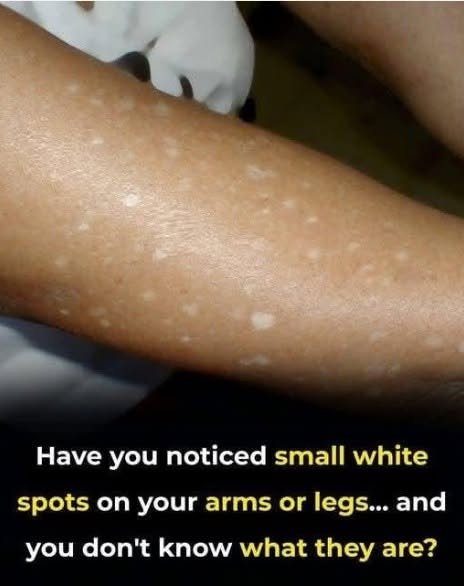
That headline is another staple of health and dermatology clickbait—designed to make you worry about small, flat white dots on your shins or forearms so you’ll click through a slideshow.
In reality, small white spots on the arms and legs are extremely common and almost always completely harmless. Dermatologists usually narrow them down to four distinct causes, depending on their texture, size, and whether they tan or itch.
1. Idiopathic Guttate Hypomelanosis (“Sun Spots”)
-
What it is: The most common cause in adults over 30 (and occasionally in younger adults with heavy sun exposure). It is essentially the opposite of a freckle—cumulative UV exposure causes localized pigment cells (melanocytes) to stop producing melanin.
-
What it looks like: Tiny, flat, porcelain-white circles or teardrops (usually 1 to 5 mm wide, like confetti) scattered on sun-exposed shins and forearms. They have sharp borders, are smooth to the touch, and never itch or hurt.
-
How to treat it: They are purely cosmetic and harmless. Daily broad-spectrum sunscreen (SPF 30+) prevents new ones from forming and keeps surrounding skin from tanning (which makes the white spots stand out more). A dermatologist can sometimes fade existing ones with topical retinoids, gentle cryotherapy, or laser treatments, though pigment doesn’t always fully return.
2. Tinea Versicolor (Superficial Yeast Overgrowth)
-
What it is: A very common, non-contagious fungal imbalance caused by Malassezia yeast—a normal microbe that lives on everyone’s skin, which can overgrow in hot, humid weather or oily, sweaty skin.
-
What it looks like: Small white, pink, or light-tan patches that may slowly merge together. Unlike sun spots, they often have a very fine, dry scale when gently scratched and may itch slightly when you sweat.
-
How to treat it: Over-the-counter antifungal creams (clotrimazole, terbinafine) or using selenium sulfide / ketoconazole dandruff shampoo as a 5-minute body wash on the affected areas for a week or two clears the yeast. (Note: Even after the yeast is gone, it can take several weeks to a few months for your normal skin color to even back out.)
3. Pityriasis Alba (Mild Eczema Aftermath)
-
What it is: A mild, low-grade form of eczema, most common in children, teens, and young adults with dry or sensitive skin.
-
What it looks like: Slightly scaly, faint white or pale-pink round/oval patches with blurry, indistinct borders (usually 1 to 4 cm wide). They become much more noticeable in the summer when the healthy skin around them tans.
-
How to treat it: Gentle skincare and heavy hydration. Switch to a fragrance-free cleanser, apply thick ceramide or plain petroleum moisturizers daily, and use sunscreen. If they are itchy or inflamed, a short course of mild over-the-counter hydrocortisone cream helps calm them down.
4. Vitiligo
-
What it is: An autoimmune condition where the immune system mistakenly attacks pigment-producing melanocytes.
-
What it looks like: Smooth, completely depigmented chalk-white patches that often appear symmetrically on both sides of the body (such as both hands, wrists, elbows, or knees) and tend to enlarge over time rather than staying tiny 2 mm dots.
-
How to treat it: Requires a dermatologist’s diagnosis. Treatments include prescription anti-inflammatory creams (like topical corticosteroids, tacrolimus, or ruxolitinib cream) and targeted narrowband UVB light therapy to encourage repigmentation.
Quick Comparison Guide
| Condition | Size & Borders | Texture | Key Clue |
| Sun Spots (IGH) | Tiny (1–5 mm), sharp edges | Completely smooth & flat | Appears on sun-exposed shins/forearms; doesn’t change size. |
| Tinea Versicolor | Small spots that merge | Faintly dry or powdery scale | Flares up in heat/humidity; responds to dandruff shampoo/antifungals. |
| Pityriasis Alba | Larger (1–4 cm), blurry edges | Slightly dry or flaky | Common with dry/sensitive skin; fades with heavy moisturizing. |
| Vitiligo | Variable, sharp edges | Completely smooth | Often symmetrical (both knees/hands) and gradually expands. |
When to See a Dermatologist: Book a visit if the spots are spreading rapidly, appearing symmetrically on both sides of your body, failing to clear after two weeks of basic moisturizing or antifungal care, or if you want an exact diagnosis before trying cosmetic treatments.