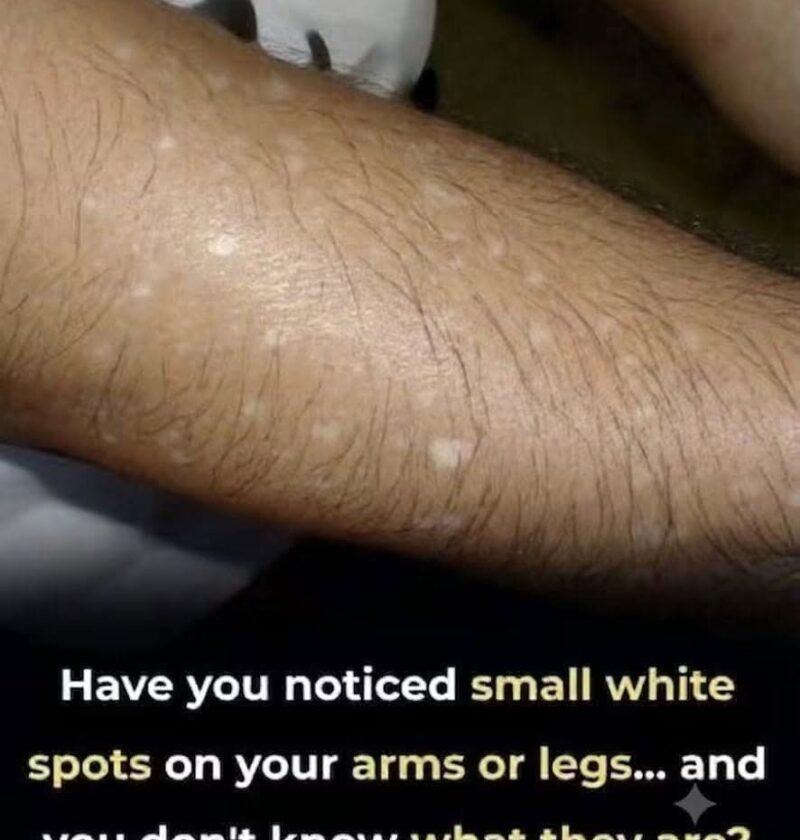
Finding small white spots on your arms and legs can be alarming, but they are a very common dermatological finding. While internet clickbait often tries to frame them as a sign of mysterious or dangerous diseases, the reality is usually much more straightforward.
Dermatologists point out that white spots on the extremities generally fall into a few distinct, identifiable categories depending on their texture, how they feel, and your skin history:
1. Idiopathic Guttate Hypomelanosis (White “Sun Spots”)
-
What they look like: Tiny, flat, smooth, confetti-like white dots or “raindrops” primarily found on the shins, calves, and outer forearms.
-
The Cause: This is the most frequent culprit for small white spots on the arms and legs. They are harmless areas of localized pigment loss resulting from cumulative, long-term ultraviolet (UV) sun exposure and aging. They do not itch or hurt, and they are entirely benign.
2. Tinea Versicolor (Mild Fungal Overgrowth)
-
What they look like: Small, slightly pale or discolored patches that may have a very fine, dry, or scaly texture. They can sometimes be mildly itchy.
-
The Cause: A natural skin yeast called Malassezia can occasionally overgrow (often triggered by heat, humidity, or heavy sweating). This yeast interferes with normal skin pigmentation, leaving lighter patches where the sun hasn’t tanned the skin evenly. It is easily treated with antifungal washes or creams.
3. Post-Inflammatory Hypopigmentation (HEALED SKIN INJURIES)
-
What they look like: Small white or light spots that match the exact shape of a previous minor scrape, bug bite, minor burn, or localized eczema flare-up.
-
The Cause: When skin experiences inflammation or minor trauma, the melanocytes (pigment-producing cells) can temporarily “fall asleep” or reduce melanin production. Once the skin heals, it can leave a pale mark that takes several months to regain its normal color.
4. Vitiligo (Autoimmune Pigment Loss)
-
What they look like: Smooth, sharply demarcated patches of completely milk-white skin.
-
The Cause: Vitiligo is a chronic autoimmune condition where the body’s immune system mistakenly targets and destroys melanocytes. While it can occasionally start as smaller spots on the hands, feet, arms, or knees, vitiligo patches tend to be distinctively crisp in shape and can expand gradually over time.
When to See a Healthcare Provider
Most small white spots on the limbs—especially flat, asymptomatic sun spots—require no medical treatment. However, you should schedule an evaluation with a dermatologist if:
-
The spots are spreading rapidly, changing texture, or becoming intensely itchy or inflamed.
-
The patches are completely devoid of pigment and expanding (raising concern for vitiligo).
-
A spot develops a rough, scaly, raised, or bleeding border that fails to heal.