That headline follows the familiar pattern of curiosity-driven wellness articles! While sleeping on your right side won’t magically cure or wreck your health overnight, sleep specialists and gastroenterologists do note that different sleeping positions have distinct mechanical effects on your body.
Here is what really happens when you sleep on your right side, how it compares to other positions, and when you might want to switch.
What Sleeping on Your Right Side Does to Your Body
-
Relief for Congestive Heart Failure: For individuals with certain types of heart conditions, lying on the right side is often more comfortable. Gravity keeps the heart positioned more stably within the chest cavity compared to sleeping on the left side, where some patients report feeling palpitations or discomfort as the heart shifts.
-
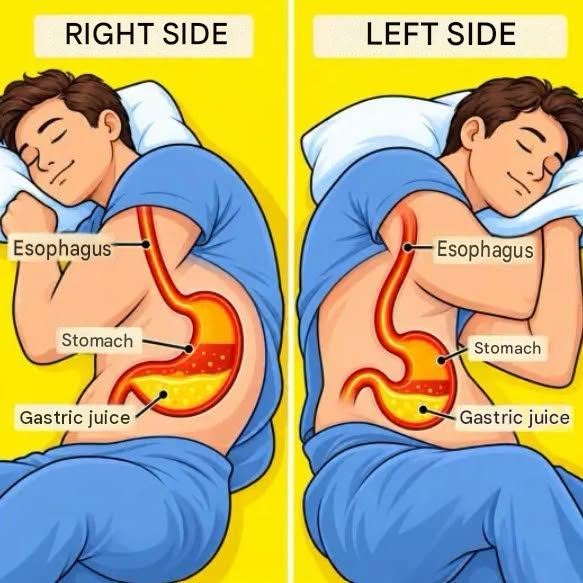
Potential Worsening of Acid Reflux (GERD): This is one of the most well-documented physiological effects. Anatomically, your stomach sits on the left side of your abdomen, and the junction where your esophagus meets your stomach rests below the level of gastric acid when you lie on your right side. This makes it much easier for stomach acid to leak upward into the esophagus, triggering heartburn.
-
Neutral Spinal Alignment (with Support): Like side sleeping in general, sleeping on your right side keeps your spine relatively neutral compared to stomach sleeping—provided you use a pillow that fills the gap between your ear and mattress, and ideally place a pillow between your knees to keep your hips aligned.
How It Compares to Other Positions
-
The Left Side Advantage: Gastroenterologists almost universally recommend left-side sleeping for anyone who suffers from acid reflux or GERD. Because of gravity and the stomach’s natural curve, sleeping on the left side keeps the gastric junction above the level of stomach acid, significantly reducing nighttime reflux episodes. (It is also the preferred position during pregnancy to optimize blood flow to the fetus).
-
Back Sleeping: Great for preventing facial wrinkles and avoiding shoulder compression, but terrible for anyone with obstructive sleep apnea or chronic snoring, as gravity causes the tongue and soft palate to collapse backward into the airway.
-
Stomach Sleeping: Generally discouraged by physical therapists and chiropractors, as it forces your neck to twist at an extreme angle for hours and flattens the spine’s natural curve, often leading to morning neck and lower back stiffness.
When to Change Position
You might want to experiment with changing your sleeping position if:
-
You wake up with frequent heartburn or a sour taste in your mouth: Switch from your right side to your left side.
-
You are pregnant: Left-side sleeping is heavily favored by obstetricians to maximize circulation to the uterus and kidneys.
-
You experience shoulder or hip impingement: If you wake up with a numb or aching arm on the side you are sleeping on, try hugging a body pillow or switching sides to relieve localized pressure.
Are you dealing with nighttime reflux, shoulder aches, or just fine-tuning your sleep ergonomics?