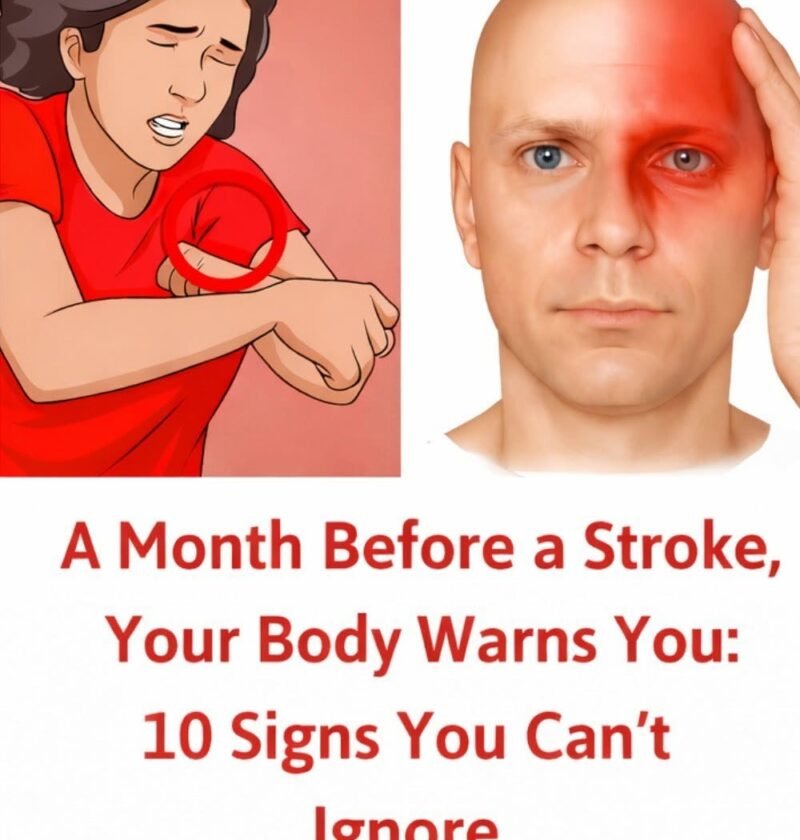
When viral health articles or social media headlines tease that “a month before a stroke, your body warns you with 10 signs,” they are blending an important medical truth with classic internet sensationalism.
The truth is that major strokes rarely happen in a total vacuum. Many patients experience subtle neurological warning signs in the days or weeks leading up to a major cerebrovascular event. However, framing them as a neat “1-month countdown” can be misleading. In medicine, these preliminary warnings are often known as Transient Ischemic Attacks (TIAs) or “mini-strokes,” and they require immediate medical attention—not a month of waiting.
The Reality of “Mini-Strokes” (TIAs)
A Transient Ischemic Attack occurs when a blood clot temporarily blocks an artery in the brain, cutting off blood flow for a short period before dissolving or dislodging on its own.
-
Why it matters: Because the symptoms usually resolve within minutes to an hour, people often brush them off as fatigue, pinched nerves, or a bad headache.
-
The Danger: A TIA is a massive red flag. Statistically, roughly 10% to 15% of people who suffer a TIA will have a major stroke within three months, with the highest risk concentrated in the first few days and weeks following the initial episode.
Subtle Red Flags Your Body Might Be Sending
While sudden, severe symptoms (like a drooping face or paralyzed arm) are classic signs of an active stroke, neurological warnings can sometimes manifest as milder, intermittent episodes weeks prior:
-
Sudden, Unexplained Weakness or Numbness: A brief, fleeting loss of strength in one arm, a leg, or one entire side of the body.
-
Temporary Speech Difficulties: Struggling to get words out, slurring speech for a few minutes, or having trouble understanding what someone else is saying.
-
Transient Vision Changes: Sudden blurring, double vision, or a temporary loss of sight in one eye (sometimes described as a “shade” pulling down over your vision).
-
Sudden Dizziness or Loss of Balance: An unprovoked bout of severe vertigo, unsteadiness, or a sudden inability to walk straight.
-
A “Thunderclap” Headache: A sudden, agonizing, and intensely severe headache unlike any ordinary migraine or tension headache you’ve experienced before.
-
Sudden Confusion: Brief episodes of disorientation, brain fog, or feeling completely out of sorts regarding time or place.
-
Unexplained Facial Asymmetry: A brief pulling sensation or slight drooping in one corner of the mouth or eyelid that resolves quickly.
-
Clumsiness in Fine Motor Skills: Suddenly dropping objects, struggling to button a shirt, or uncharacteristic handwriting difficulties.
-
Sudden Numbness on One Side of the Face: A tingling or deadened sensation localized entirely to the left or right cheek and jaw.
-
Brief Altered Consciousness: Sudden, unexplained spells of lightheadedness, wooziness, or feeling faint without a clear trigger.
The FAST Test (When to Seek Emergency Help)
If you or someone around you experiences any of these symptoms—even if they disappear after five minutes—do not wait a month, and do not sleep it off. Neurologists rely on the FAST acronym to evaluate acute stroke risk:
-
Face Drooping: Does one side of the face droop, or is it numb?
-
Arm Weakness: Is one arm weak or numb? Ask the person to raise both arms; does one drift downward?
-
Speech Difficulty: Is speech slurred, are they unable to speak, or are they hard to understand?
-
Time to Call 911: If you observe any of these signs, call emergency services immediately, even if the symptoms go away. Quick medical intervention during a TIA window can prevent a permanent, life-altering stroke.