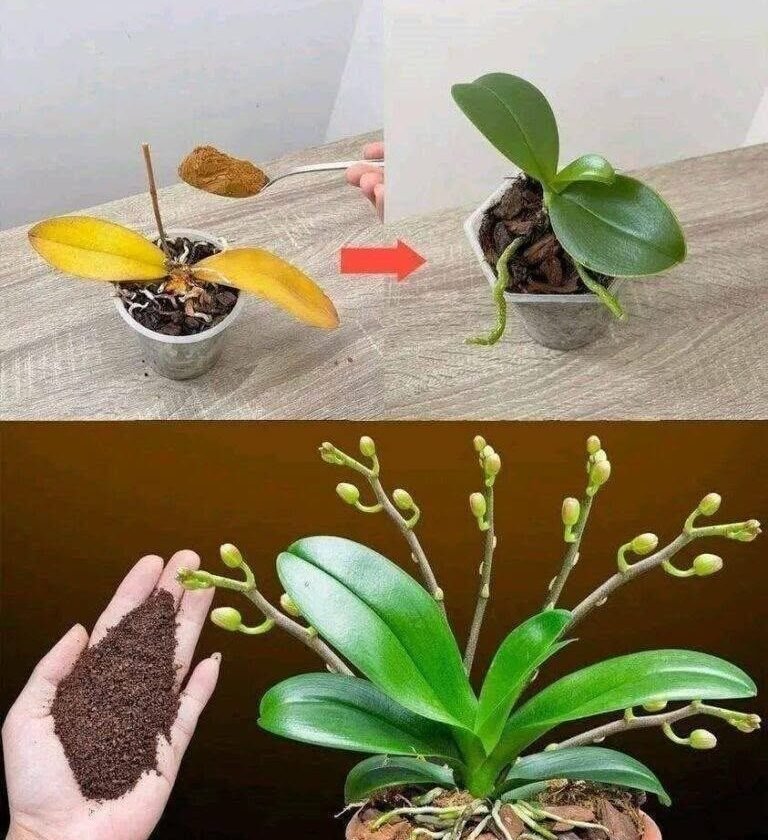
Orchid care often attracts viral home remedies and “miracle” fertilizer recipes online, promising that a spoonful of a household ingredient will cause an orchid to burst into heavy blooms.
While orchids do benefit from nutrients during their growing season, dumping a random household substance straight onto the roots or soil usually does more harm than good. Here is a breakdown of why these viral claims circulate, how they hold up to reality, and how to safely encourage your orchid to bloom.
What Orchids Actually Need vs. Viral “Miracles”
Orchids (most commonly Phalaenopsis or moth orchids grown as houseplants) are epiphytes. In nature, they grow clinging to tree bark in tropical rainforests, meaning their roots are exposed to the air and rain rather than sitting in rich garden soil or heavy compost.
Because of this unique biology:
-
They Do Not Like Heavy Matter: Adding thick food items, pure liquids, or solid powders directly into the pot can smother the roots, block air circulation, and encourage mold, fungus gnats, or root rot.
-
They Need Diluted Nutrients: When fertilizing orchids, the golden rule among growers is “weakly, weekly.” Standard fertilizers must be heavily diluted (often to 1/4 or 1/8 strength) because orchid roots are extremely sensitive to chemical burn from concentrated salts.
Common Kitchen “Tips” for Orchids (And Why to Be Cautious)
-
Cinnamon / Spices: Sometimes suggested to prevent fungus or encourage growth, cinnamon can dry out or burn delicate orchid tissues if applied heavily to roots. (It is sometimes used sparingly as a dry antiseptic on a cut stem or leaf, but not as a general root fertilizer).
-
Sugar or Honey Water: The idea is that providing sugar feeds the plant energy. In reality, pouring sugary liquids into a pot feeds bacteria and fungi, attracting pests rather than helping the plant.
-
Epsom Salt or Rice Water: While magnesium or dilute starches offer trace nutrients, applying them blindly without understanding the plant’s current cycle can disrupt the delicate balance of the potting media (usually bark or sphagnum moss).
What Actually Makes an Orchid Bloom?
If your orchid has stopped blooming and is just producing green leaves, it is almost never because it lacks a secret kitchen ingredient. Instead, blooming is usually triggered by environmental cues:
-
Light: Orchids need bright, indirect sunlight. If they are sitting in a dark corner, they won’t have the energy to produce flowers.
-
Temperature Drop: Many orchids (especially Phalaenopsis) naturally initiate a flower spike in response to a slight, natural temperature drop at night (about 10°F cooler than daytime temperatures) over a few weeks in the fall or winter.
-
Proper Watering: Letting the roots dry out slightly between waterings (watering only when the roots inside a clear plastic pot turn silvery-gray rather than green) keeps the root system healthy.
Have you noticed your orchid dropping buds, or are you trying to get a stubborn plant to re-bloom after a flowering cycle