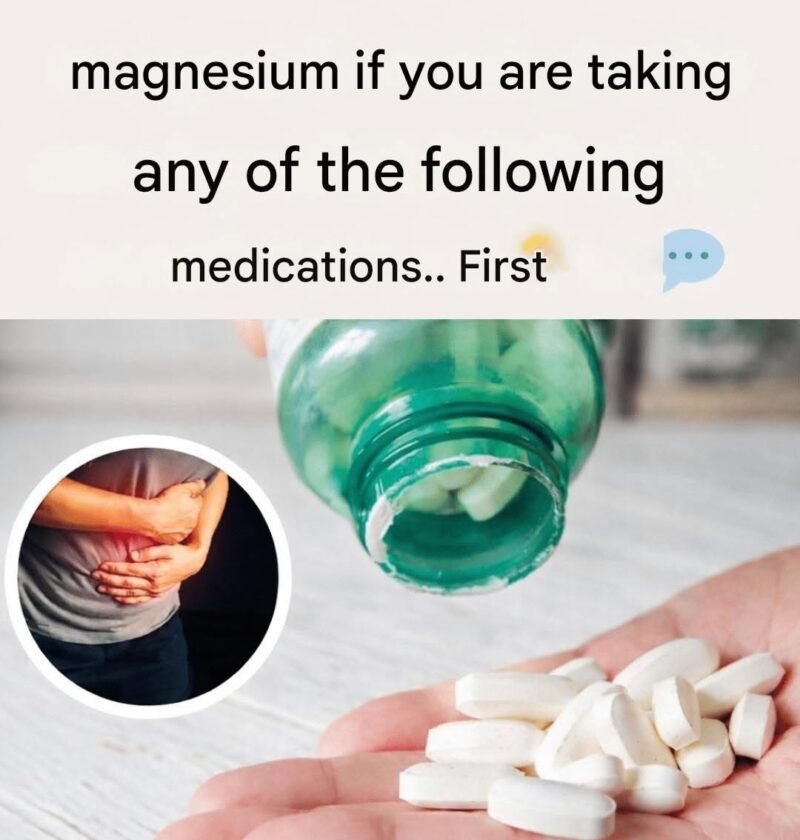
“Never Use Magnesium If You Take These Medications” — What’s Actually True?
That headline is too absolute. Most people taking medications do not have to avoid magnesium completely, but magnesium supplements can interfere with certain medicines or change how much magnesium your body retains.
O
ODs.gov
+1
Medicines that deserve particular attention
Certain antibiotics — Magnesium can bind to tetracycline antibiotics such as doxycycline and quinolone antibiotics such as ciprofloxacin and levofloxacin, reducing their absorption. They generally need to be taken several hours apart.
O
ODs.gov
Oral bisphosphonates — Medicines such as alendronate can be absorbed less effectively if taken too close to magnesium. NIH recommends separating them by at least 2 hours.
O
ODs.gov
Some diuretics (“water pills”) — Furosemide and hydrochlorothiazide can increase magnesium loss, while potassium-sparing diuretics such as spironolactone can have the opposite effect.
O
ODs.gov
Long-term proton-pump inhibitors (PPIs) — Medicines such as omeprazole, lansoprazole, and esomeprazole can sometimes cause low magnesium levels when used for a prolonged period.
O
ODs.gov
Levothyroxine — Magnesium-containing products may interfere with absorption, so it’s prudent to separate them rather than taking them together. Recent research also found reduced levothyroxine exposure when magnesium aspartate was taken simultaneously.
M
MedlinePlus
+1
Another important issue: kidney function
Your kidneys normally remove excess magnesium. People with impaired kidney function can be more vulnerable to magnesium toxicity, particularly from supplements or magnesium-containing laxatives/antacids.
O
ODs.gov
+1
Excess supplemental magnesium can cause diarrhea, nausea and abdominal cramping; extremely high levels can cause serious heart and nervous-system problems.
O
ODs.gov
Don’t stop your medication
If you’re taking a prescription medicine, don’t stop it just because you want to take magnesium. Often the solution is simply changing the timing or avoiding an unnecessary supplement.
Also, magnesium naturally present in foods isn’t the same as taking a concentrated supplement. The NIH’s upper limit of 350 mg/day for adults applies to magnesium from supplements and medications, not magnesium naturally present in food.
O
ODs.gov
If you give me the names of your medications (including doses), I can check which ones interact with magnesium and tell you how far apart they should generally be taken.
O
M
Sources