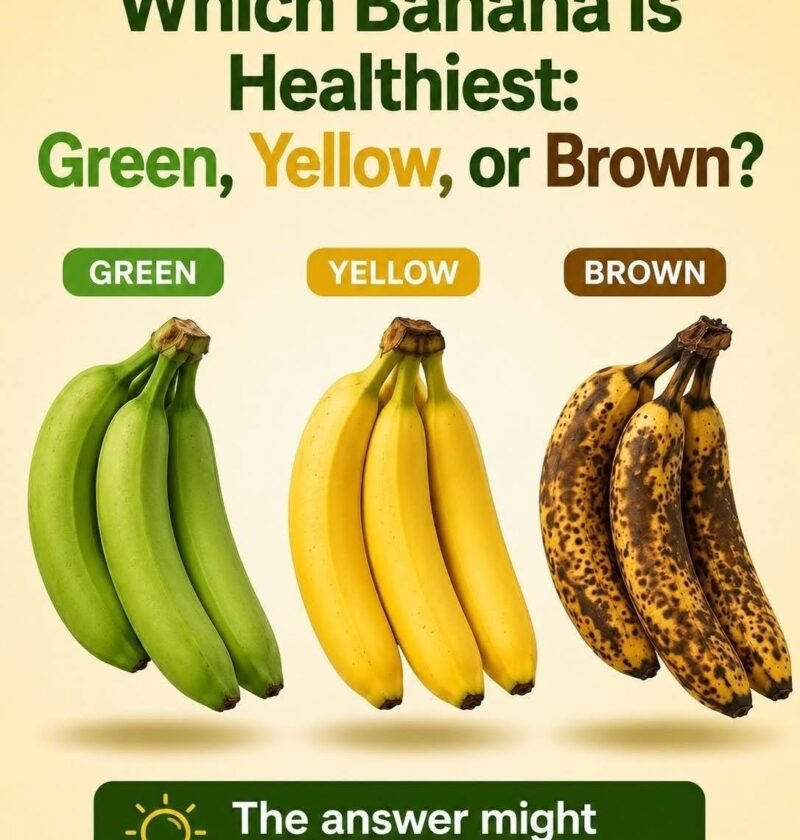
The headline “Green, Yellow, or Brown …Which Banana Is Actually the Healthiest?” is a fun spin on nutritional choices, often treating the fruit’s ripeness stages like a competitive sport where only one color can wear the crown.
In nutritional science, there is no single “healthiest” banana. Instead, different ripening stages offer distinct nutritional profiles and digestive benefits. As a banana ripens from firm and green to spotted and brown, its internal chemistry transforms dramatically.
Let’s look at how the nutritional composition shifts across each stage and which banana best suits your health goals.
The Evolution of a Banana: How Ripeness Changes Chemistry
As starches inside the fruit break down into simple sugars over time, both the taste and the physiological impact on your body change:
1. Green Bananas (The Resistant Starch Powerhouse)
-
What they are: Underripe, firm, and slightly starchy or chalky in taste.
-
Nutritional breakdown: Green bananas are packed with resistant starch—a type of dietary fiber that escapes digestion in the small intestine and acts as a prebiotic in your colon, feeding beneficial gut bacteria.
-
Health benefit: Because resistant starch breaks down very slowly, green bananas have a much lower glycemic index (GI). They cause a gradual, blunted rise in blood sugar, making them an excellent choice for individuals managing diabetes or insulin sensitivity.
2. Yellow Bananas (The Balanced Energy Source)
-
What they are: Fully ripe, bright yellow, firm yet sweet, and easy to peel.
-
Nutritional breakdown: At this stage, most of the resistant starch has converted into simple natural sugars (fructose, glucose, and sucrose), and the vitamin C content peaks.
-
Health benefit: Yellow bananas provide rapid, easily digestible carbohydrates paired with a healthy dose of potassium and vitamin B6. They are the ideal pre- or post-workout snack when your muscles need a quick, accessible energy boost.
3. Brown-Spotted / Brown Bananas (The Antioxidant & Digestibility Stage)
-
What they are: Overripe, heavily speckled, or entirely brown and soft.
-
Nutritional breakdown: The starch has almost entirely converted to simple sugars (which is why they taste so sweet), and their antioxidant levels reach their peak. As chlorophyll breaks down, antioxidant compounds increase significantly.
-
Health benefit: Brown bananas are the easiest on the digestive tract. Because the starches are fully broken down, individuals with sensitive stomachs, gastritis, or recovering from a gastrointestinal bug can digest them with minimal effort. (They are also fantastic for baking moisture-rich banana bread without added oils).
The Takeaway
There is no wrong color when it comes to bananas—it all depends on what your body needs at the moment:
-
Choose green if you want to support gut health and keep your blood sugar steady.
-
Choose yellow for everyday energy, athletic performance, and balanced vitamins.
-
Choose brown if you need fast, gentle digestion or are tossing them into a blender for a smoothie.