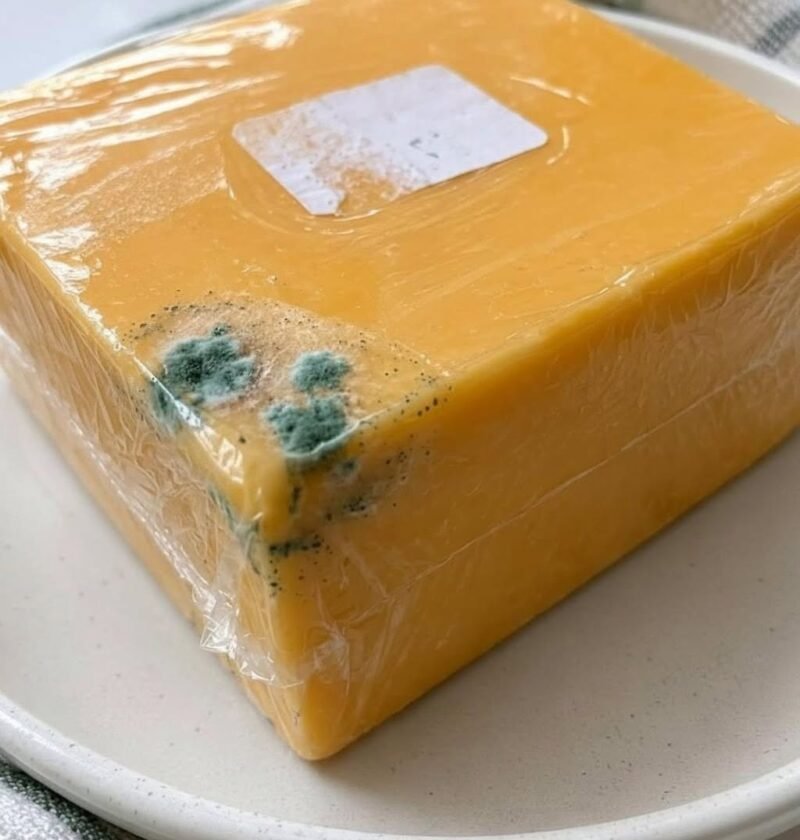
Whether you can save your cheddar or need to toss it depends entirely on the type of cheese and how deep the mold goes.
Here is the quick rule of thumb for cheddar: Because cheddar is a hard, low-moisture cheese, you can usually salvage it.
🧀 What to Do with Moldy Cheddar
-
Cut it away: Cut off the moldy spot, making sure to slice at least 1 inch (2.5 cm) around and below the visible mold.
-
Protect the knife: Keep the knife from touching the mold itself so you don’t accidentally spread spores to the clean parts of the cheese.
-
Re-wrap it: Wrap the remaining clean cheese in fresh parchment or wax paper, followed by plastic wrap or a sealed container, to keep air out and prevent new mold growth.
🛑 When to Toss the Whole Block
While hard cheeses like cheddar, parmesan, and Swiss are dense enough to block mold roots from spreading deep, you should throw the cheese away if:
-
It’s a soft cheese: Cream cheese, cottage cheese, ricotta, goat cheese, or shredded/sliced cheeses have high moisture content. Mold roots can easily thread through the entire package. Toss them immediately if you see mold.
-
It’s covered in mold: If the mold has taken over a large portion of the block, it’s safer to let it go.
-
It smells or tastes off: If the cheese has a sharp, ammonia-like odor or tastes bitter/spoiled far away from the mold spot, it’s past its prime.
💡 Fun Fact: Many artisan cheddars are actually aged in environments where harmless mold naturally forms on the rind. However, the green or blue spots popping up on a block in your home fridge are usually stray spores from the air (like penicillin variants).
Have you noticed mold on a block of cheddar in your fridge, or are you just curious about food safety rules?