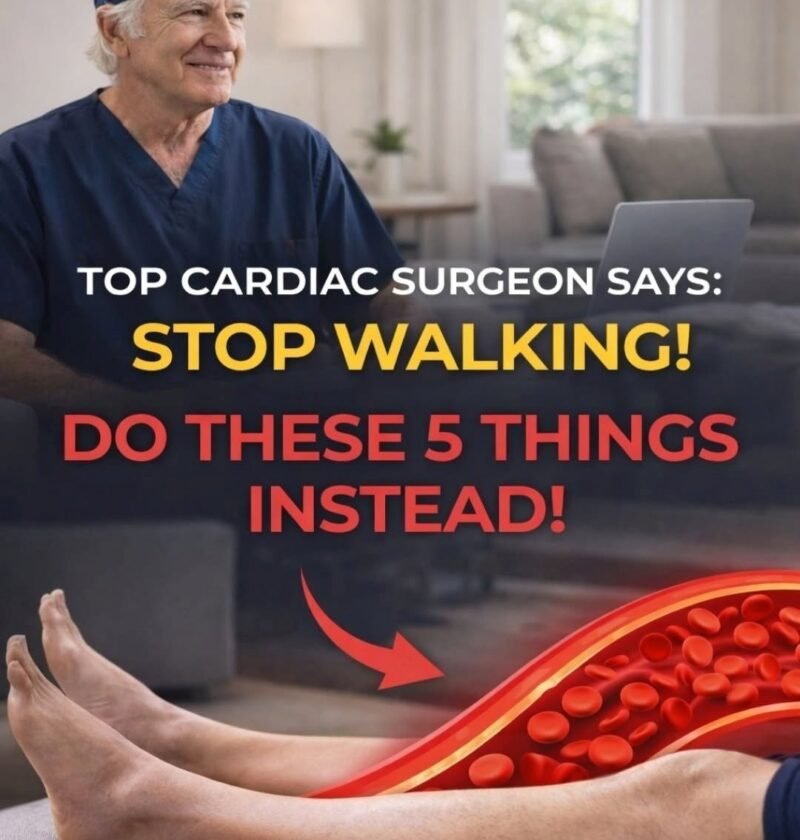
Headlines declaring “Forget walking! Do these 5 exercises after 60 — Approved by surgeons!” use classic clickbait formatting by pitting one form of exercise against another. They want you to believe that walking is suddenly obsolete and that a secret set of movements holds the key to anti-aging.
While walking is fantastic for cardiovascular health, endurance, and mental well-being, the core message behind these headlines actually touches on an important medical truth: walking alone is not enough to maintain muscle mass, bone density, or functional strength as you age.
Orthopedic surgeons, geriatricians, and physical therapists heavily emphasize that adding targeted resistance and stability work after 60 is essential to protect joints, prevent falls, and combat sarcopenia.
Here is why walking shouldn’t be forgotten, what these “surgeon-approved” style exercises actually achieve, and how to build a balanced routine:
Why Walking Isn’t Enough on Its Own
-
The Limits of Low-Impact Cardio: Walking is low-impact and wonderful for your heart, lungs, and circulation. However, because it is non-load-bearing in terms of heavy resistance, it does very little to stimulate muscle growth or build bone mineral density.
-
The Need for Force: Bones and muscles grow stronger in response to mechanical tension and resistance. Without a challenge, natural muscle loss (sarcopenia) and bone density decline (osteopenia/osteoporosis) will continue unchecked, regardless of how many miles you walk.
The 5 Core Movement Patterns Experts Actually Recommend After 60
Instead of secret “miracle” motions, medical professionals focus on functional movement patterns that protect your independence and joint integrity:
1. Sit-to-Stands (Chair Squats)
-
Why it matters: Leg strength—particularly in your quads and glutes—is the number one predictor of independent living and fall prevention as you age.
-
How it works: Rising from a sturdy chair without using your hands mimics the exact physical mechanics needed to get out of a car, a couch, or off the toilet safely.
2. Wall or Counter Push-Ups
-
Why it matters: Upper body and core strength often deteriorate when people focus exclusively on leg-based cardio like walking. Pushing movements maintain chest, shoulder, and arm strength, which are vital for pushing doors open, carrying groceries, or catching yourself if you stumble.
3. Step-Ups or Heel-Toe Walks (Balance & Stability)
-
Why it matters: Falls are a major health risk for older adults. Exercises that challenge your balance—such as walking heel-to-toe in a straight line or slow, controlled step-ups onto a low platform—train your proprioception (your body’s awareness in space) and strengthen stabilizing ankle and hip muscles.
4. Standing Rows (Using Resistance Bands)
-
Why it matters: Modern life pulls our shoulders forward into a hunched posture. Using a resistance band anchored to a door or heavy object to pull your elbows back strengthens your upper back and rear shoulders, counteracting spinal rounding and supporting upright posture.
5. Glute Bridges
-
Why it matters: Sitting for long periods deconditions the glutes and lower back, often leading to lower back pain. Lying on your back and lifting your hips engages your posterior chain, protecting your spine and stabilizing your pelvis.
The Balanced Approach: Don’t “Forget” Anything
The ideal fitness routine after 60 isn’t about choosing either walking or strength training—it’s about combining them:
-
Keep Walking: Use daily walks for your heart, mental clarity, and low-impact movement.
-
Add Resistance 2 to 3 Times a Week: Dedicate 20 minutes a couple of times a week to bodyweight or light resistance exercises to protect your muscles, bones, and joints.
Have you been trying to mix up your physical activity routine recently, or are you looking for safe ways to build strength without heavy gym equipment?