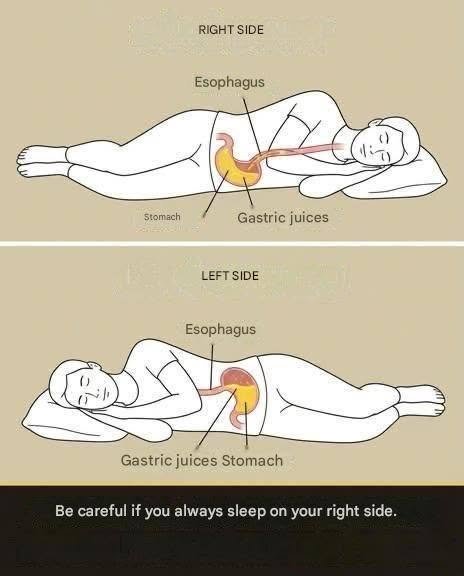
Headlines or viral posts warning that “if you always sleep on your right side, you…” typically try to alarm readers with dramatic claims about digestion, heart health, or internal organ damage.
While sleeping position does have some minor, scientifically documented impacts on the body, sleeping on your right side is not a hidden health hazard or a medical mistake.
Here is what science actually says about right-side sleeping, what the claims get wrong, and how different sleep positions affect your body:
1. The Right-Side vs. Left-Side Digestion Debate
The most common claim against right-side sleeping centers on stomach anatomy.
-
The Claim: Proponents of left-side sleeping argue that because the stomach curves to the left, sleeping on your right side allows stomach acid to pool against the lower esophageal sphincter, worsening acid reflux (GERD).
-
The Reality: While clinical studies do show that left-side sleeping can reduce acid reflux episodes for people with chronic GERD (due to gravity keeping the gastric junction above the level of gastric acid), sleeping on your right side does not cause acid reflux if you don’t already have it. If you suffer from severe heartburn, adjusting your sleep position or elevating the head of your bed can help, but casual right-side sleeping is harmless for healthy digestion.
2. The Heart Health Myth
-
The Claim: Some viral posts claim that right-side sleeping puts pressure on your heart because the heart sits toward the center/left of your chest.
-
The Reality: Your heart is securely suspended in the mediastinum (the central compartment of the thoracic cavity) by sturdy ligaments and supported by surrounding tissue. Simply rolling onto your right side does not cause your heart to shift, compress, or strain under its own weight.
3. Potential Pros of Right-Side Sleeping
Interestingly, right-side sleeping actually has documented benefits for certain people:
-
Relief for Heart Failure Patients: Studies have shown that some patients with certain types of heart failure instinctively or comfortably prefer sleeping on their right side because it minimizes uncomfortable sensations of heart movement or palpitations compared to the left side.
-
Pregnancy Comfort: While left-side sleeping is generally recommended during later pregnancy to optimize blood flow to the fetus and prevent the uterus from pressing on major blood vessels, alternating sides or using supportive pregnancy pillows is common and safe.
The Bottom Line: Comfort is King
For the vast majority of healthy adults, your body naturally shifts positions throughout the night, and no single side-sleeping position is inherently dangerous.
The most important factor for a healthy night’s sleep is spinal alignment and waking up well-rested without joint stiffness or chronic pain. Unless a doctor has specifically advised you to sleep in a certain position for a medical condition like severe acid reflux or late-stage pregnancy, the best sleeping position is simply the one that lets you fall and stay asleep comfortably.
Do you naturally gravitate toward one side when you sleep, or do you find yourself tossing and turning throughout the night?