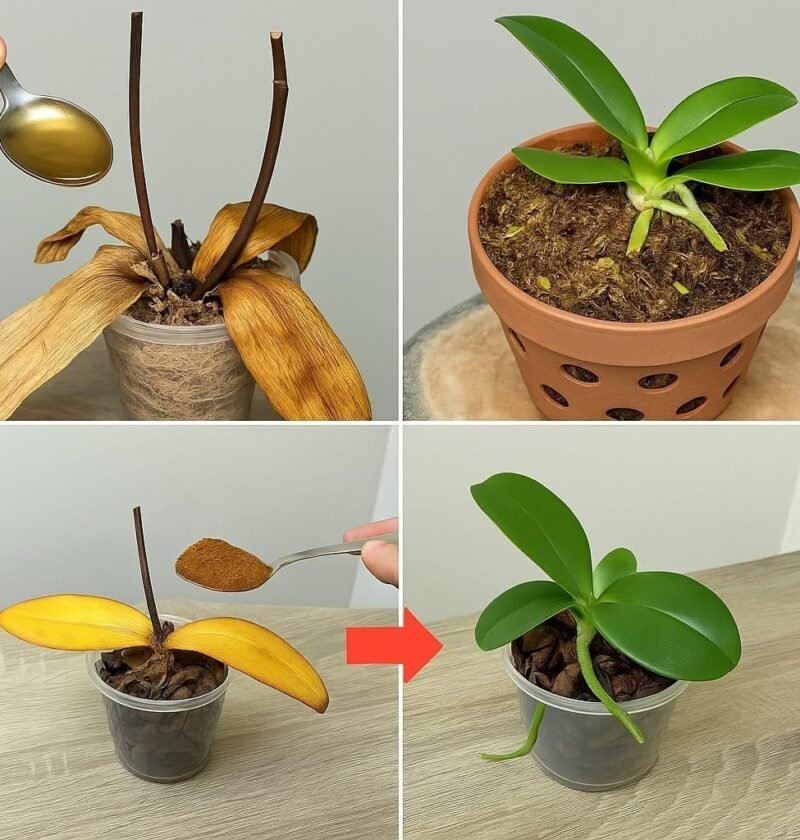
That headline is likely garden-hack clickbait. There isn’t a single spoonful of household powder that can reliably revive dead orchid roots or make an orchid bloom all year.
If an orchid has damaged or apparently dead roots, the useful approach is to remove genuinely dead roots and correct the growing conditions:
-
Check the roots: Healthy roots are usually firm and green/silver-white. Dead roots tend to be brown/black, mushy, hollow, or papery.
-
Trim dead roots with a clean, sterilized cutting tool. Don’t remove firm, healthy roots just because they’re not green.
-
Repot in fresh, airy orchid medium such as appropriately sized bark, using a pot with excellent drainage.
-
Avoid constantly wet roots. Root rot is commonly associated with excessive moisture and poor aeration.
-
Give bright, indirect light rather than harsh midday sun.
-
Water according to the orchid and environment, rather than on a rigid daily schedule.
-
Fertilize lightly during active growth; fertilizer cannot resurrect tissue that is already dead.
-
Be cautious with cinnamon, baking soda, hydrogen peroxide, or other viral “one-spoon” remedies. Some may be useful in very specific circumstances, but sprinkling them indiscriminately onto roots can cause additional damage.
Also, “blooms all year round” isn’t a realistic promise for most orchids. Healthy orchids can rebloom repeatedly, but flowering depends on species, light, temperature, nutrition, and the plant’s natural growth cycle.
If you send me a photo of the orchid and its roots, I can tell you which roots look dead and what I’d do next.