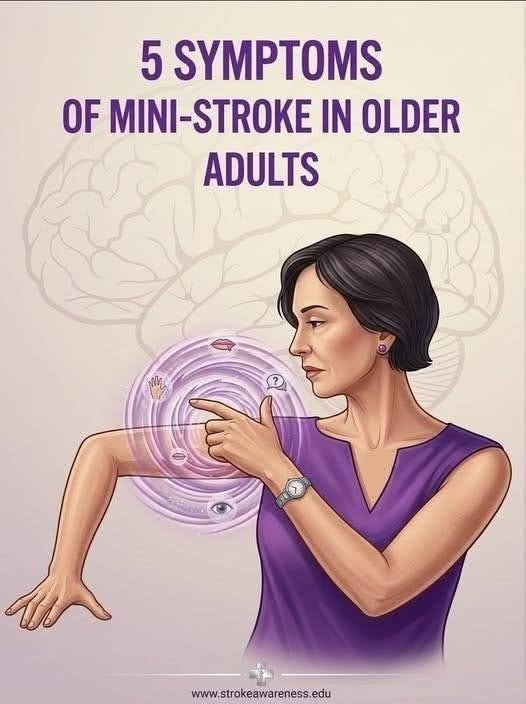
A mini-stroke, medically known as a Transient Ischemic Attack (TIA), occurs when blood flow to a part of the brain is temporarily blocked. Unlike a major stroke, the blockage is brief, and symptoms typically resolve within a few minutes to 24 hours without permanent damage.
However, a TIA is a critical warning sign—often called a “warning stroke.” Up to a third of people who have a TIA will eventually have a full stroke, with the highest risk occurring within the days and weeks immediately following the mini-stroke. In seniors, symptoms can sometimes be subtle or mistakenly dismissed as normal signs of aging or fatigue.
Recognizing these five key symptoms can save a life:
1. Sudden Weakness or Numbness (Especially on One Side)
-
What it feels like: A sudden loss of strength or a heavy, numb feeling in the face, arm, or leg. A senior might suddenly drop a cup, struggle to lift one arm, or find that one side of their mouth droops when they try to smile.
-
Why it happens: A temporary clot disrupts the specific area of the brain responsible for controlling motor function and sensation on the opposite side of the body.
2. Sudden Confusion, Trouble Speaking, or Difficulty Understanding
-
What it feels like: Slurred speech, garbled words, trouble getting thoughts out, or an inability to comprehend what others are saying. The person may sound as though they are confused or disoriented.
-
Why it happens: The blockage affects the brain’s language centers (such as Broca’s or Wernicke’s areas), temporarily interrupting speech production and comprehension.
3. Sudden Trouble Seeing in One or Both Eyes
-
What it feels like: A sudden blurring, darkening, double vision, or complete temporary loss of vision in one or both eyes. Seniors sometimes mistake this for a sudden decline in eyesight or cataracts acting up.
-
Why it happens: Reduced blood flow to the occipital lobe or the optic pathways disrupts visual processing.
4. Sudden Trouble Walking, Loss of Balance, or Coordination
-
What it feels like: A sudden onset of dizziness, unsteadiness, stumbling, or a feeling of spinning (vertigo) combined with a sudden inability to coordinate movements.
-
Why it happens: The interruption in blood flow hits the cerebellum or brainstem, which are responsible for balance, posture, and spatial coordination.
5. Sudden, Severe Headache with No Known Cause
-
What it feels like: A crushing, blinding headache that hits with sudden, explosive force and has no clear trigger (such as a migraine history or dehydration).
-
Why it happens: While more commonly associated with hemorrhagic strokes, a sudden severe vascular disruption can trigger acute head pain.
The FAST Rule & What to Do
Medical professionals use the FAST acronym to spot stroke signs quickly:
Face Drooping: Does one side of the face droop or is it numb?
Arm Weakness: Is one arm weak or numb? If the person tries to raise both arms, does one drift downward?
Speech Difficulty: Is speech slurred, are they unable to speak, or are they hard to understand?
Time to call emergency services: Even if the symptoms disappear completely within minutes, call emergency services immediately. A TIA requires urgent medical evaluation to prevent a major stroke.