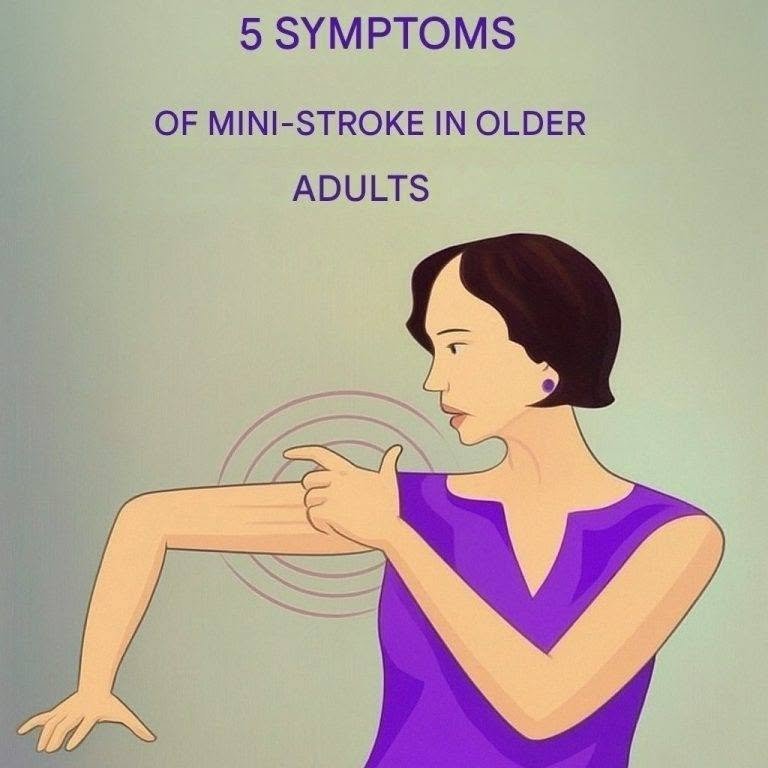
A mini-stroke—medically known as a Transient Ischemic Attack (TIA)—occurs when blood flow to a part of the brain is briefly blocked. While the symptoms typically last only a few minutes to an hour and leave no permanent brain damage, a TIA is a critical medical emergency. It acts as a major warning sign that a full-scale stroke could happen soon—often within days.
In older adults, these warning signs are sometimes mistakenly written off as “just getting older” or fatigue. Recognizing them quickly can save a life.
1. Sudden Facial Drooping or Numbness
-
What it looks like: One side of the face suddenly droops or feels stiff. The mouth may pull to one side, or the eyelid may sag.
-
How to check: Ask the older adult to give a big smile. If the smile is uneven or one side of the face does not move, it is a red flag.
2. Sudden Weakness or Numbness in an Arm or Leg
-
What it looks like: A sudden loss of strength or a heavy, numb feeling, typically restricted to one side of the body (e.g., the right arm and right leg together). They may drop items unexpectedly or struggle to stand.
-
How to check: Ask them to lift both arms in front of them and hold them up for 10 seconds. If one arm drifts downward or they cannot raise it at all, take immediate action.
3. Slurred Speech or Trouble Understanding
-
What it looks like: Speech suddenly becomes slurred, garbled, or completely incomprehensible. Alternatively, the person may look awake and alert but be completely unable to find the right words or understand what you are saying to them.
-
How to check: Ask them to repeat a simple sentence, such as “The grass is green.” If they struggle to repeat it or sound confused, it points to a neurological disruption.
4. Sudden Vision Changes in One or Both Eyes
-
What it looks like: Abrupt blurring, double vision, or a sudden partial/complete loss of sight (sometimes described as a “shadow” or “curtain” coming down over one eye).
-
Why it matters: Older adults often dismiss vision changes as worsening cataracts or tired eyes, but an abrupt shift in vision is a classic vascular warning sign.
5. Sudden Loss of Balance, Dizziness, or Vertigo
-
What it looks like: Unexplained, intense dizziness, a spinning sensation (vertigo), or sudden unsteadiness that makes walking or standing upright impossible.
-
Why it matters: While everyday balance issues are common in aging, a sudden onset accompanied by stumbling, confusion, or any of the symptoms above indicates a disruption in the areas of the brain controlling coordination.
Remember the FAST Test
To easily recall these signs, medical professionals use the B.E. F.A.S.T. acronym:
-
B — Balance: Sudden loss of balance or coordination?
-
E — Eyes: Sudden trouble seeing in one or both eyes?
-
F — Face: Does one side of the face droop?
-
A — Arms: Does one arm drift downward when raised?
-
S — Speech: Is speech slurred or are they hard to understand?
-
T — Time: If you observe any of these signs—even if they go away completely within minutes—call emergency services (such as 911) immediately.
Important Takeaway: Never wait to see if mini-stroke symptoms “wear off.” Because it is impossible to tell at the outset whether an event is a temporary TIA or a major, permanent stroke, emergency medical evaluation is vital right away.