Clickbait headlines love to frame medical emergencies with a precise listicle format, but when it comes to vascular events in older adults, recognizing the warning signs quickly is genuinely critical.
A Transient Ischemic Attack (TIA)—commonly known as a “ministroke”—occurs when a blood clot temporarily blocks an artery supplying blood to the brain. Unlike a full stroke, the blockage resolves quickly, and symptoms typically vanish within minutes to an hour.
However, medical professionals view a TIA as an urgent medical emergency and a major red flag that a severe, permanent stroke may follow soon after. In seniors, these warning signs are sometimes mistakenly brushed off as “normal signs of aging” or fatigue.
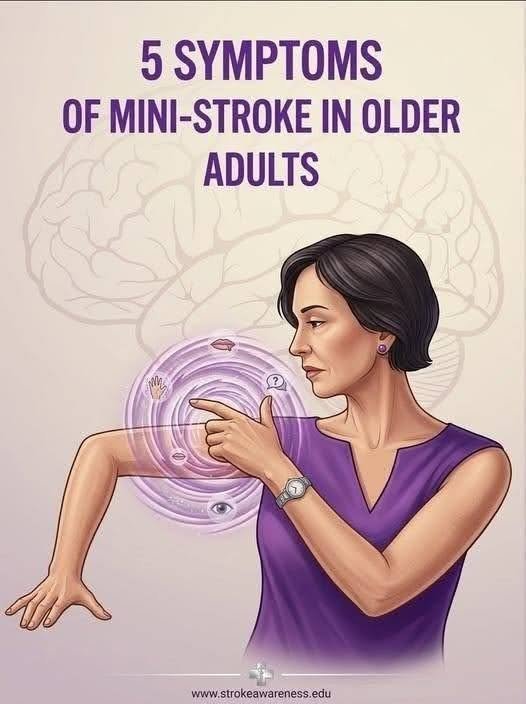
Here are 5 key symptoms of a TIA in seniors that should never be ignored:
1. Sudden, One-Sided Weakness or Numbness
-
What it looks like: A senior might suddenly find it difficult to lift their arm, notice that one leg feels heavy or unresponsive, or experience sudden numbness running down the entire right or left side of the body.
-
Why it happens: The area of the brain controlling movement on the opposite side of the body is temporarily starved of oxygen. If they drop a cup or struggle to push themselves out of a chair on one specific side, treat it immediately.
2. Sudden Facial Droop or Asymmetry
-
What it looks like: When trying to smile or speak, one side of the face droops, the mouth pulls to one side, or the eyelid sags unexpectedly.
-
Why it happens: Cranial nerves controlling facial muscles lose temporary signaling from the brain. Asking the person to show their teeth or smile makes this asymmetry immediately apparent.
3. Sudden Slurred, Garbled, or Incoherent Speech
-
What it looks like: Speech becomes abruptly slurred, words are jumbled, or the person seems entirely unable to form coherent sentences or find the right words. They may also struggle to understand what you are saying to them.
-
Why it happens: A TIA affecting the language centers of the brain (such as Broca’s or Wernicke’s areas) disrupts the ability to process and articulate speech.
4. Sudden, Unexplained Vision Changes
-
What it looks like: Sudden blurring, double vision, or a sudden loss of vision in one or both eyes—sometimes described as a “shade” or “curtain” pulling down over one eye.
-
Why it happens: Temporary disruption of blood flow to the optic nerve or the occipital lobe of the brain can instantly impair visual processing.
5. Sudden Loss of Balance, Vertigo, or Unsteadiness
-
What it looks like: The senior suddenly feels intensely dizzy, loses their coordination, stumbles while walking, or complains that the room is spinning—especially when not accompanied by a simple inner-ear issue.
-
Why it happens: When a TIA affects the cerebellum or brainstem (the areas responsible for coordination and balance), it robs the body of spatial stability.
The Crucial Takeaway: Remember “FAST”
If you observe any of these symptoms in an older adult—even if they disappear completely after five minutes—do not wait to see if they improve.
Use the FAST test (Face drooping, Arm weakness, Speech difficulty, Time to call emergency services) and call emergency services immediately. A prompt medical evaluation allows doctors to clear artery blockages, adjust blood pressure or thinning medications, and potentially prevent a catastrophic stroke.