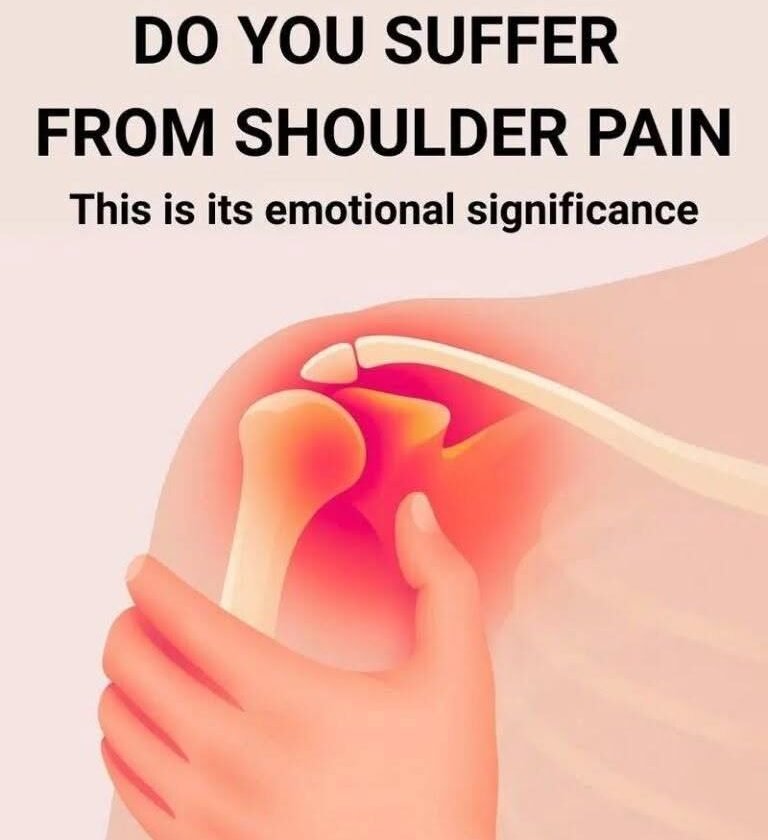
In holistic health, mind-body medicine, and various somatic traditions, the shoulders are often viewed as the physical manifestation of burden, responsibility, and emotional weight.
While modern medicine attributes shoulder pain to physical causes—such as rotator cuff strains, bursitis, tendonitis, frozen shoulder, or nerve compression—mind-body perspectives explore how chronic stress and unexpressed emotions can manifest physically through muscle tension and posture.
Here is an exploration of the emotional meanings commonly associated with shoulder pain, broken down by how we experience them:
1. “Carrying the Weight of the World”
-
The Concept: The most common emotional association with shoulder pain is over-responsibility. Shoulders are literally built to carry loads. When you take on too much emotional labor, caretaking, financial stress, or professional pressure, your body may physically tense up to “hold” that weight.
-
Reflective Questions: Are you taking responsibility for things that aren’t yours to fix? Do you feel unsupported or overwhelmed by your current obligations?
2. Duty, Obligation, and “Shoulds”
-
The Concept: In linguistic symbolism, the word “should” shares a root with the shoulder. People experiencing chronic shoulder tension often live by rigid internal rules of what they should do, rather than what they genuinely want or have the capacity to do. This internal conflict creates friction between duty and desire.
-
Reflective Questions: Where in your life are you acting out of pure obligation? Are you ignoring your own needs to meet everyone else’s expectations?
3. Protection and Guarding
-
The Concept: Biologically, when we feel threatened, stressed, or vulnerable, our bodies instinctively pull the shoulders upward and forward to protect the neck and chest (a primitive defensive posture). Chronic stress can trap the body in a low-grade “fight-or-flight” response, keeping the traps and shoulder muscles permanently contracted.
-
Reflective Questions: What or who are you bracing yourself against? Do you feel emotionally safe in your current environment or relationships?
4. Power, Agency, and Suppressed Anger
-
The Concept: Shoulders are tied to our ability to push forward, reach out, or push things away. If you feel powerless in a situation—unable to “push back” against a job, a relationship, or a life circumstance—that suppressed frustration and unexpressed anger can translate into tension in the upper body and shoulders.
-
Reflective Questions: Where do you feel helpless or restricted? What would you like to push away or stand up to if you had the freedom to do so?
Left vs. Right Shoulder: Symbolic Distinctions
In many mind-body frameworks (such as traditional mind-body mapping or psychosomatic medicine), the left and right sides of the body carry different symbolic meanings:
-
The Left Shoulder: Often associated with internal, personal, or relational matters—such as family, emotional vulnerability, nurturing, and personal life.
-
The Right Shoulder: Often associated with external, public, or authoritative matters—such as work, career, financial survival, and interactions with society or masculine/father figures.
Bridging the Physical and Emotional
While exploring emotional meanings can offer profound personal insights and help identify sources of chronic stress, it should not replace medical evaluation. Unresolved physical issues like a torn labrum, calcium deposits, or nerve impingement require proper diagnosis and treatment from a physician or physical therapist.
Often, the most effective healing happens when you address both: treating the physical mechanics of the joint while simultaneously examining the emotional boundaries, stressors, and lifestyle habits that may be keeping your muscles locked in a state of chronic defense.